

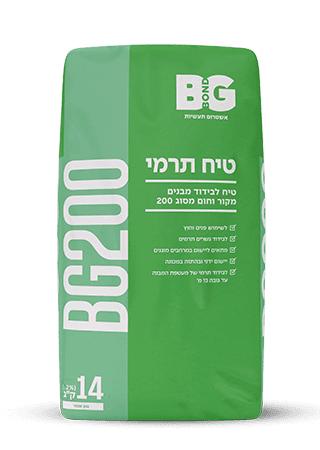
BG 200 thermal plaster
Waterproofing Solutions
Thermal
Type 200 cold and heat building insulating plaster
For interior and exterior use
For thermal insulation of building envelope up to a height of 13 m.
For thermal insulation of bridges
Suitable for application in protected spaces
Manual and machine sprayed application
Properties
- Volume: 80 litres
- Application temperature: 5°C - 35°C
- Specific gravity following oven drying: below 200(±3%) kg. per cu.m.
- Work usability duration: up to an hour
- Capillary absorption coefficient: K < 0.4 kg/ m²h¹ᐟ²
- Typical consumption: 0.8 kg. per sq.m. for a thickness of 1 mm.
- Typical thermal resistance (R) for thickness of 1: 0.143 m²K/W
- Thermal conductivity when dry (λ1): 0.061 m²K/W
- Design thermal conductivity (λ): 0.065 m²K/W
- Fire classification under SI 755: V.4.3
- Compressive strength following 28 days: in excess of 0.6 MPa
- Bond strength: equal to or greater than 0.06 MPa
- Meets SI 1414 requirements for 200 designation
- Meets SI 1045 requirements for thermal insulation
- Meets SI 5075 requirements for protected spaces
- Meets SI 5282 requirements for green construction
Ingredients
Powder: cement, graded aggregate, expanded polystyrene, light aggregates, polymers and powdered additives
Advantages
- For thermal insulation of building envelope
- For thermal insulation of bridges
- For application on primer plaster
- For application in protected spaces ("mamad"s)
- For interior and exterior application up to a height of 13 m.
- For manual or machine sprayed application
- Breathes and allows water vapour passage
- Ready for use after addition of water
Safety Guidelines
- The company's warranty is limited solely to the nature and quality of the products and is no substitute for the user's reponsibility; the user is required to check the suitability of the product for the required application.
- We reserve the right to update or modify the data and recommendations without prior notice.
- In any event, this document is not such as to approve or recommend any deviation or aberration from the regulations and laws of the State of Israel, in particular the Planning and Building Law, 5725-1965, and Standards issued by the Standards Institute of Israel.
- Likewise, this document is no substitute for perusal of the aforesaid law and regulations, nor does it constitute a reference for them.